How to Combine Data Science and Generative AI for Career Growth
Look at almost any AI job listing in India right now and you'll spot something odd: employers want one person who can do two jobs. They want someone who understands data the old-fashioned way, statistics, Python, predictive models, and who can also build the new stuff, LLMs, RAG pipelines, AI agents that ship. That overlap is where the money and the momentum are moving, and most professionals are still standing on one side of it.
The good news is you don't have to choose. Data Science and Generative AI aren't competing skill sets; they're two layers of the same stack. Master both and you stop being the analyst who hands off insights or the prompt tinkerer who can't touch the data. You become the person who connects the pipes end to end. Here's how to build that combination without quitting your day job.
Why pairing the two skills pays more than either one alone
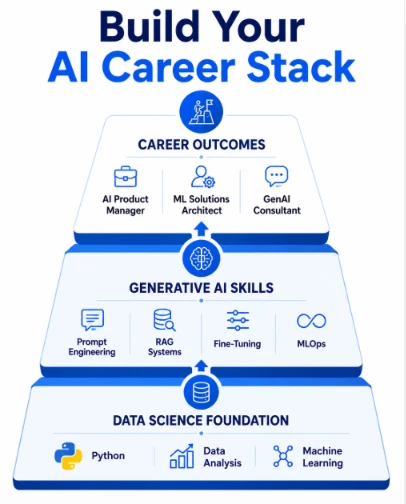
Think of Data Science as the foundation and Generative AI as the floor you build on top. Data Science teaches you to clean messy datasets, run hypothesis tests, build models that predict things, and explain all of it to people who don't speak math. Generative AI teaches you to design retrieval systems, fine-tune models on your own data, and deploy applications people can use. Separately, each is valuable. Stacked together, they make you rare.
The market is rewarding integrators, not pure specialists. Anyone can learn to write a decent prompt now. What stays scarce is the person who can wire a generative model into real data infrastructure, judge whether its outputs are accurate or biased, and tie the whole thing to a business outcome. That blend is what pushes you toward roles like AI Product Manager, ML Solutions Architect, or GenAI Consultant, the jobs that sit above the commodity layer and command better pay.
What skills you need to build first
Start at the bottom and work up. The foundational layer is Data Science: Python and SQL, data wrangling with Pandas and NumPy, the statistics behind A/B testing, and core machine learning like regression, classification, and clustering. You also need to visualize and tell stories with data, because insights nobody understands are worthless.
Once that base is solid, layer in the generative skills. This is where prompt engineering, RAG system design, fine-tuning open models, and MLOps come in. The real differentiator, though, is the glue between the two layers, building pipelines that flow from raw data to insight to generative output, and being able to spot when an AI response is confidently wrong. You don't have to learn all of this in one sprint. Nail the fundamentals first, then specialize, which is exactly the path an advanced generative ai course is designed to support.
Why a structured program beats teaching yourself
You can absolutely cobble this together from free tutorials. Most people who try end up with scattered knowledge and no portfolio to show for it. A structured program forces sequence, accountability, and crucially, real projects you can put in front of a hiring manager.
Take CareerAmbit's advanced generative ai certification by upGrad as a concrete example. It runs five months, fully online, built around working professionals with 120-plus learning hours. It opens with a four-week Python refresher, so nobody gets left behind, then moves into prompt engineering and LLM workflows, RAG systems and embeddings, app development and deployment with Flask and LangChain, and finally multimodal and diffusion models. You finish with a capstone backed by Microsoft AI Immersion training. That's the full arc from foundations to deployable apps, in order, with support along the way.
What the projects and certifications actually get you
A certificate that just says you watched some videos won't move a recruiter. What moves them is proof you built something. This is where the project-led approach matters: across the course you ship six-plus portfolio-grade applications with real deployments, things like ShopAssist AI, a retrieval chatbot called Mr.HelpMate AI, an image-generation build named PixxelCraft AI, and a news automation project. Each one is something you can demo in an interview instead of just describing.
On the credential side, the program carries an Advanced Certificate from upGrad plus NSDC recognition, which is government-backed, and a Microsoft certificate through the AI Immersion masterclasses. The toolchain is the one employers actually use: ChatGPT and OpenAI APIs, LangChain, LlamaIndex, Hugging Face, AWS, Pandas, and NLTK. By the end you've touched eight-plus tools and shipped real builds, which is a different conversation from "I completed an online course."
Who this combination is right for
This path fits more people than you'd expect. Engineers wanting to move into AI roles, software and IT professionals looking to upskill into LLM work, and data analysts or scientists who want to deepen into AI-driven workflows all fit naturally. Product managers and tech entrepreneurs building AI-enabled products benefit too, because understanding both layers means you can lead these projects instead of just managing them from a distance.
The one real prerequisite is some programming background, since the work is hands-on and project-based. If you've coded in Python through coursework or a job, you're ready. You don't need a computer science degree or years of AI experience, you need the willingness to build, ship, and iterate, which is exactly what the course is structured around.