How to Choose the Right Online Course in India: A 2026 Decision Guide
To choose the right online course in india, start by working backwards from the career you want, not the course that looks popular. The right online course in India is the one whose accreditation, format, fees, and outcomes line up with where you are now and where you want to be in two to three years. Once you fix that target, the shortlist of programs that fit gets small fast, and the decision stops feeling overwhelming.
That sounds obvious, yet most people do the opposite. They pick a trending subject, enrol, and only later ask whether the degree is recognised or whether employers in their field even value it. With more than 50 million Indians now learning online and the market growing at roughly 23 to 28 percent a year, there has never been more choice, which also means there has never been more noise to cut through. This guide gives you a clear order of decisions, so you choose once and choose well.
Why Does Choosing an Online Course Feel So Confusing in 2026?
It feels confusing because the market exploded faster than most people's ability to compare options. India is now the second largest e-learning market after the United States, and industry data from IBEF projects that the edtech sector will reach US $313 by 2030. Hundreds of universities launched online arms at once, each with its own brochure language, so two programs that look identical can differ wildly in recognition and quality.
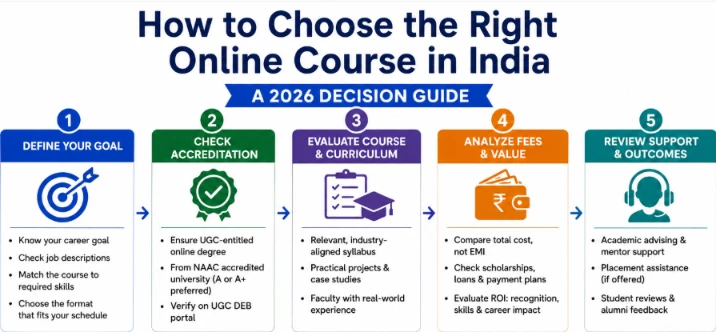
The fix is not to read more brochures. It is to apply the same five filters to every option, so you are comparing like with like. When you compare online courses against a fixed checklist instead of a feeling, the marketing gloss stops mattering and the real differences surface.
What Should You Check First Before Anything Else?
Check accreditation first, because nothing else matters if the qualification is not recognised. In India the signal you want is a UGC-entitled online degree from a NAAC accredited university, ideally with an A or A+ grade. The University Grants Commission maintains a public list of institutions approved to offer online programs, and you can verify any claim directly on the UGC DEB portal before you pay a rupee.
Such an entitlement carries the same academic value as the on-campus version, which is the whole point. If a program cannot show you its entitlement letter or hides behind vague phrases like government approved, treat that as a red flag and move on. This single check eliminates a surprising number of options and saves you from a credential nobody will honour.
How Do You Match a Course to Your Actual Career Goal?
Match the course to the job description, not the job title. Pull up five live listings for the role you want, note the skills and qualifications they repeat, and then judge each program against that list. A digital marketing certificate that teaches SEO, analytics, and paid media maps cleanly to what employers ask for, while a generic one does not.
This is where format matters too. Working professionals, who make up close to 60 percent of online learners, usually need a self-paced or weekend model rather than fixed live classes. If you are a fresher, a structured cohort with mentorship may serve you better. There is no universally best format, only the one that fits your week. The broader set of online degree programs in India now spans everything from foundational bachelor's degrees to executive diplomas, so the goal is fit, not prestige for its own sake.
Which Marketing Trends Are Quietly Shaping What You See?
Know that a lot of what reaches you is engineered, so read it with a trained eye. Three marketing shifts now dominate how online education is sold in India and understanding them helps you separate substance from spin.
First, AI-driven personalisation. Platforms increasingly use your browsing to push specific programs through retargeting ads and tailored email funnels, which is why the same course seems to follow you around the internet. Popularity in your feed is a function of ad spend, not always quality. Second, EMI and zero-cost framing. Fees are now marketed as monthly figures starting near 999 rupees a month because a small number feels easier than a large one, so always calculate the full program cost before deciding. Third, outcome-led storytelling, where placement numbers and salary jumps headline every landing page. These can be real but ask for the methodology and the sample size behind any figure.
The takeaway is not cynicism. It is literacy. Once you recognise these patterns, you can enjoy a slick ad and still make a decision based on accreditation and fit rather than persuasion.
Is an Online MBA or a Skill Certificate the Better Bet?
Choose a degree when you need a recognised qualification and a certificate when you need a specific skill quickly. An online MBA in India makes sense if you are aiming for managerial roles, a promotion that lists a postgraduate degree as a requirement, or a career pivot that needs a formal credential. Programs from established universities now run from twelve to twenty-four months and are built around working schedules.
A short certificate in data science, digital marketing, or product management makes more sense when you already have a degree and simply need to prove a capability. Many learners do both in sequence, a degree for the credential and a certificate for the edge. The right call depends entirely on your starting point, which is exactly the kind of question a counsellor can settle in one conversation.
How Do You Make the Final Call Without Second-Guessing?
Run every shortlisted program through one last scorecard, then commit. Rate each option on five things: recognition, curriculum relevance, format fit, total cost, and post-course support. Give each a simple score out of five, add them up, and the winner usually becomes obvious. If two are tied, the tiebreaker is almost always support, because guidance during admission and after enrolment is what separates a smooth experience from a frustrating one.
When you are still genuinely torn, talk to someone whose job is matching learners to programs. A round of free career counselling online can compress weeks of indecision into a focused thirty-minute call, mapping your goals and background to the programs that fit. There is no cost to explore, and you only ever pay a university if you choose to enrol.